

Side lying Bottle Feeding
When most people picture bottle feeding, they imagine a baby lying on their back with a bottle straight up and down causing milk to flow quickly. If milk is flowing too quickly, you might notice a baby clicking, gulping, leaking milk, pulling away, or coughing. Moving the baby into a side-lying position for bottle feeding can help reduce that stress and support better coordination while feeding.
In the side-lying position, baby is held on their side during bottle feeds rather than flat on their back. The bottle is held parallel to the floor, which slows the flow of milk and allows baby to control the pace more independently, creating a feeding experience that feels more physiologic and responsive.
Many babies benefit from a slower, more controlled feeding pace. Some babies are especially sensitive to fast flow, including:
Newborns
Premature infants
Babies who cough or choke during feeds
Babies with reflux
Babies who become overwhelmed at the bottle
Breastfed babies transitioning between breast and bottle
Benefits of Side-Lying Bottle Feeding
Helps baby control milk flow
Mimics pace and positioning of feeding at the breast
Encourages paced feeding
May reduce coughing, choking, and air swallowing
Supports more coordinated suck-swallow-breathe patterns
Can reduce preference for fast-flow bottle feeding
Helpful for babies with reflux or feeding difficulties
How to Position Baby
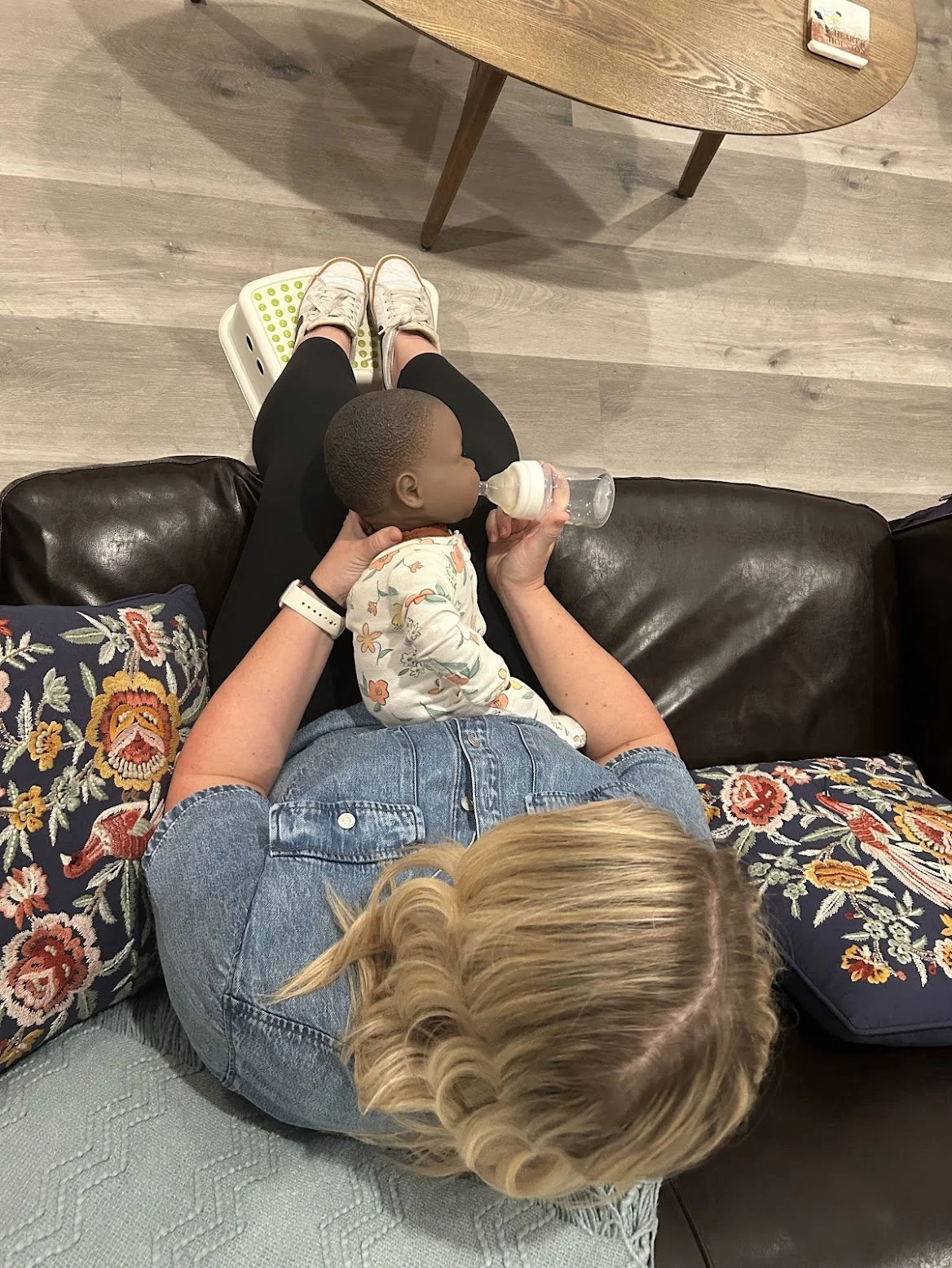
Hold baby in your lap with head by your knees and gently turn them onto their side so their body is in an “L” shape with their bottom against your stomach and legs out towards your hip
Baby’s ear, shoulder, and hip should stay aligned.
Their head should be slightly elevated above their hips.
Let baby “latch” onto the bottle
Gently touch the nipple to the lips and wait for a wide-open mouth.
Baby should draw the nipple in rather than having it inserted forcefully.
Use Paced Bottle Feeding
Hold the bottle parallel to the floor
This slows milk flow and gives baby more control.
For more info on Paced Bottle Feeding
Watch for active feeding pattern with pauses
Babies naturally pause to breathe and rest.
They should do several sucks, followed by a swallow, a pause for a few breaths, then repeat. This is an active feeding pattern.
If you see gulping, coughing, milk leaking, wide eyes, or fast breathing, tip the bottle down briefly to stop flow.
The baby isn’t the only person who should be comfortable while feeding. It is important that the caregiver that is feeding the bottle is also comfortable. Try the following variations to see what feels best for you.
Alternative Feeding positions

Side Lying Bottle Feeding with Pillow Support
Use a pillow to elevate the baby and give your arms support.

Inclined Side Lying position
Elevate your feet on a stool or couch so infant is at an incline and use a pillow at your back to give the caregiver support.

Football Side Lying Bottle Feeding
Use a pillow to feed in football position.
Bottle feeding is more than delivering nutrition — it’s communication, regulation, connection, and comfort. Side-lying bottle feeding is a tool that can help your baby feel more comfortable and controlled while feeding.
It encourages us to slow down, observe, and respond to what the baby is telling us in real time. Babies are individuals with their own needs and preferences. Finding what works for your baby and family can bring peace and confidence to your parenting journey.